
Where We Be
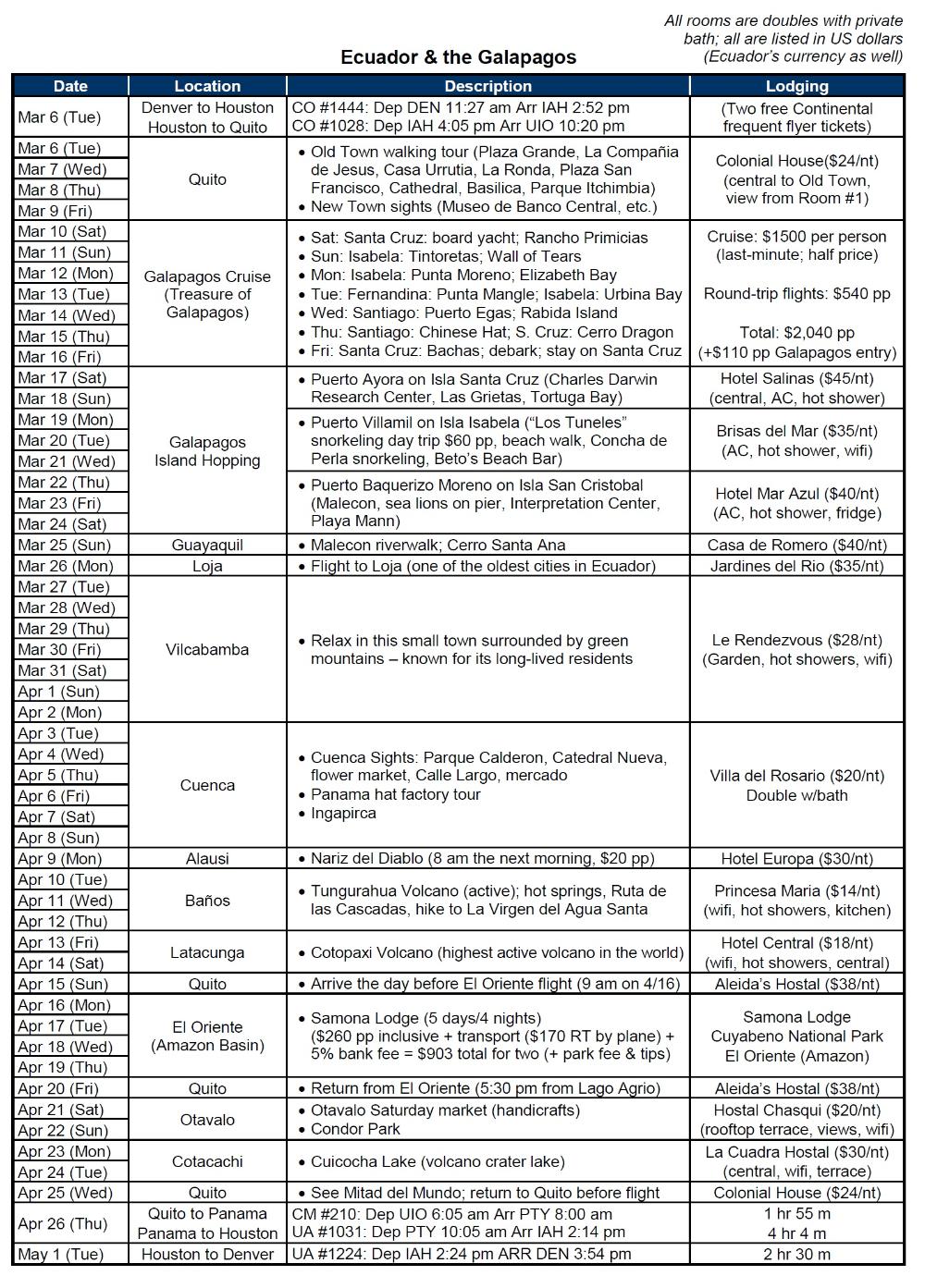
 | |  | |  | |  | |  | |  | |  |


| ECUADOR TIPS |
Transportation
Buses in Ecuador are wonderfully affordable. Essentially, $1 US per
person = 1 hour of travel throughout Ecuador. You can pay directly on the
bus. A bus "assistant" keeps track of who has boarded and will come to
collect money from you sometime during the journey. He will usually have
change for a $5 or $10 bill (we never tried using a $20). The assistant
also stores your bigger luggage under the bus and makes sure only you
pick it up when you get off. If you speak some Spanish, you can ask this
person to tell you when you have reached your destination (i.e., if it's not
the last stop).
We never had any issues with attempted theft on any bus, but good
sense dictates you store valuables at your feet or on your lap -- not
overhead or hidden out of sight under the seat. We always kept
passports, cash, and electronics in a day bag close at hand on board the
bus, while storing our bigger bags (containing mostly clothing) in the
storage compartment below.
Taxis are also quite affordable in Ecuador. Usually $1 or $2 will cover you
in smaller cities like Cuenca, Loja, or Otavalo. In bigger cities like Quito or
Guayaquil it might cost up to $4 or $5 if you're going a long way. We give
the taxi driver our destination and ask the fare before getting in (assuming
there isn't a meter which often there isn't). A better option in Quito is to
take the trolley for 25 cents if you're going a long distance -- it runs up
and down the length of the city and offers a great way to get from Old
Town to New Town.
We 'splurged' on one trip from Loja to Cuenca, taking an Elite Tours van
for $12 per person. The van was much faster than the bus over this
mountainous route (it took us 3 hours instead of 5 or 6 hours).
For added flexibility, consider "open-jaw" flights to and from the
Galapagos -- e.g., fly from Quito to Isla Santa Cruz on the way there, then
Isla San Cristobal to Guayaquil on the way back.
To get between the main islands of the Galapagos, you can take an
inter-island water taxi for $25 per person.
Lodging
We stayed at hostels and inexpensive lodgings throughout our stay in
Ecuador and usually paid between $20 and $40 per night for a double
room with private bath. Ironically, more expensive hotels typically charge
you a 12% VAT tax (making the room even more expensive) while
inexpensive hostels do not. Inexpensive lodgings usually do not include
heat -- your room is simply the ambient temperature. Usually this is not a
problem as the climate in Ecuador is temperate (if you're at elevation) to
hot (if you're at sea level). But occasionally in cities like Quito and Cuenca
we had to wear layers in the evening to stay warm inside our room until we
got under the covers. In the Galapagos (hot) we paid an extra $10 per
night for AC and considered it worth every penny.
Buses in Ecuador are wonderfully affordable. Essentially, $1 US per
person = 1 hour of travel throughout Ecuador. You can pay directly on the
bus. A bus "assistant" keeps track of who has boarded and will come to
collect money from you sometime during the journey. He will usually have
change for a $5 or $10 bill (we never tried using a $20). The assistant
also stores your bigger luggage under the bus and makes sure only you
pick it up when you get off. If you speak some Spanish, you can ask this
person to tell you when you have reached your destination (i.e., if it's not
the last stop).
We never had any issues with attempted theft on any bus, but good
sense dictates you store valuables at your feet or on your lap -- not
overhead or hidden out of sight under the seat. We always kept
passports, cash, and electronics in a day bag close at hand on board the
bus, while storing our bigger bags (containing mostly clothing) in the
storage compartment below.
Taxis are also quite affordable in Ecuador. Usually $1 or $2 will cover you
in smaller cities like Cuenca, Loja, or Otavalo. In bigger cities like Quito or
Guayaquil it might cost up to $4 or $5 if you're going a long way. We give
the taxi driver our destination and ask the fare before getting in (assuming
there isn't a meter which often there isn't). A better option in Quito is to
take the trolley for 25 cents if you're going a long distance -- it runs up
and down the length of the city and offers a great way to get from Old
Town to New Town.
We 'splurged' on one trip from Loja to Cuenca, taking an Elite Tours van
for $12 per person. The van was much faster than the bus over this
mountainous route (it took us 3 hours instead of 5 or 6 hours).
For added flexibility, consider "open-jaw" flights to and from the
Galapagos -- e.g., fly from Quito to Isla Santa Cruz on the way there, then
Isla San Cristobal to Guayaquil on the way back.
To get between the main islands of the Galapagos, you can take an
inter-island water taxi for $25 per person.
Lodging
We stayed at hostels and inexpensive lodgings throughout our stay in
Ecuador and usually paid between $20 and $40 per night for a double
room with private bath. Ironically, more expensive hotels typically charge
you a 12% VAT tax (making the room even more expensive) while
inexpensive hostels do not. Inexpensive lodgings usually do not include
heat -- your room is simply the ambient temperature. Usually this is not a
problem as the climate in Ecuador is temperate (if you're at elevation) to
hot (if you're at sea level). But occasionally in cities like Quito and Cuenca
we had to wear layers in the evening to stay warm inside our room until we
got under the covers. In the Galapagos (hot) we paid an extra $10 per
night for AC and considered it worth every penny.
Lodging (continued)
In some of the less expensive hostels only Spanish is spoken. Knowing a
few key words ahead of time (like "Cuanto cuesta?" for "How much?" and
"Doble con baño" for "Double with bath") can help you communicate more
easily.
If your room has an anemic shower, Robin found a good solution: borrow
a plastic container from the kitchen, fill it with hot water from the shower,
then use that plus the shower water to get clean.
Wifi is usually available in most hostels and inexpensive lodgings in
Ecuador these days -- if not directly in your room, then in the lobby.
Food
"Almuerzos" are an awesome lunch deal -- a set-price lunch for $1.50 or
$2.50. Just ask for the almuerzo when you sit down and they'll bring you
the meal -- usually soup, entree, and fruit juice.
Fruits and veggies are incredibly cheap in Ecuador. We often paid just 5
cents per apple or banana (with no bargaining).
Wine is fairly pricy in Ecuador because it is imported -- usually from Chile
or Argentina. We discovered you could buy a liter-size box of decent
Concha y Toro wine from Chile for $6 or $7 from grocery stores or small
vendors (if you looked around a bit). Local beer is affordable and readily
available. "Blue laws" can sometimes make it hard to buy wine or beer on
Sundays -- even at restaurants.
Money
Ecuador uses the US Dollar as its currency. Bring small bills with you --
lots of $5 and $10 bills. When paying for a room or a meal (i.e., any
bigger expense), try to break a $20 to keep your stash of small bills intact.
Many vendors won't be able to break anything bigger than a $5 or $10.
Credit cards are rarely accepted unless you're paying for an airline ticket
or a big excursion, and often there is a 3% to 6% fee to use it. When
buying our Galapagos cruise we were able to negotiate the credit card fee
down from 6% to 3%.
Miscellaneous
Bring lots of Ziplock baggies of different sizes. They come in handy for all
sorts of things -- storing wet bathing suits, keeping items dry when in the
rainforest, temporarily holding small food items in your day pack,
organizing belongings in your pack, etc.
Public toilets rarely have toilet paper so it's wise to bring some with you on
the trip and keep it handy.
Laundry services are incredibly cheap in Ecuador. There's hardly a point
in doing it yourself when it can be washed, dried, and folded for you for
just a few dollars. It can usually be picked up later that same day or the
next morning.
In some of the less expensive hostels only Spanish is spoken. Knowing a
few key words ahead of time (like "Cuanto cuesta?" for "How much?" and
"Doble con baño" for "Double with bath") can help you communicate more
easily.
If your room has an anemic shower, Robin found a good solution: borrow
a plastic container from the kitchen, fill it with hot water from the shower,
then use that plus the shower water to get clean.
Wifi is usually available in most hostels and inexpensive lodgings in
Ecuador these days -- if not directly in your room, then in the lobby.
Food
"Almuerzos" are an awesome lunch deal -- a set-price lunch for $1.50 or
$2.50. Just ask for the almuerzo when you sit down and they'll bring you
the meal -- usually soup, entree, and fruit juice.
Fruits and veggies are incredibly cheap in Ecuador. We often paid just 5
cents per apple or banana (with no bargaining).
Wine is fairly pricy in Ecuador because it is imported -- usually from Chile
or Argentina. We discovered you could buy a liter-size box of decent
Concha y Toro wine from Chile for $6 or $7 from grocery stores or small
vendors (if you looked around a bit). Local beer is affordable and readily
available. "Blue laws" can sometimes make it hard to buy wine or beer on
Sundays -- even at restaurants.
Money
Ecuador uses the US Dollar as its currency. Bring small bills with you --
lots of $5 and $10 bills. When paying for a room or a meal (i.e., any
bigger expense), try to break a $20 to keep your stash of small bills intact.
Many vendors won't be able to break anything bigger than a $5 or $10.
Credit cards are rarely accepted unless you're paying for an airline ticket
or a big excursion, and often there is a 3% to 6% fee to use it. When
buying our Galapagos cruise we were able to negotiate the credit card fee
down from 6% to 3%.
Miscellaneous
Bring lots of Ziplock baggies of different sizes. They come in handy for all
sorts of things -- storing wet bathing suits, keeping items dry when in the
rainforest, temporarily holding small food items in your day pack,
organizing belongings in your pack, etc.
Public toilets rarely have toilet paper so it's wise to bring some with you on
the trip and keep it handy.
Laundry services are incredibly cheap in Ecuador. There's hardly a point
in doing it yourself when it can be washed, dried, and folded for you for
just a few dollars. It can usually be picked up later that same day or the
next morning.
2012